
Showing posts with label supply. Show all posts

Friday, October 03, 2014

Expanding Airport Parking Options Without Building new Parking Lots or Parking Garages

One of the major differences between economic decisions in a free market and decisions by government bureaucrats in a socialist economic system is that anyone in a free market has freedom to see a perceived need and try to satisfy it while bureaucrats tend to be limited not only to their area of expertise but also limit themselves to the constraints of the status quo.

I saw an example of this on a recent trip which took me across the nation by air.

Once airborne, airplanes are a fast way to travel over a long distance.  However, getting to the airport can be both time consuming and stressful.  This is especially true when one lives in a small city, like Tucson where I live, and decides to take advantage of more choice and often lower fares offered by a major airport in a nearby large city like Phoenix.

While there are often van and bus lines offering reasonably priced service to nearby large airports, there is still the problem of scheduling and parking.  For early morning flights there is the added problem of first, the service not offering service early enough to make the connection and, second, even if they do offer early service this usually requires getting up at one or two in the morning in order to catch a shuttle in time to make your flight.

Driving to the airport is an option but here one has to contend with the congestion that surrounds large airports as well as having to leave your car in some expensive and often distant lot with little security.

A few years ago I discovered some motels near Phoenix Sky Harbor Airport offering free parking to those who spent the night before the flight at their hotel.  This enabled my family and me to drive to Phoenix the night before, get up at a reasonable hour for the flight and take the motel's free shuttle directly to the terminal while leaving our car behind in their lot.

For my wife's and my recent trip only a couple of motels offered this service and the parking was limited to one week while we were going to be gone for three weeks.  With a 7 a.m. flight there was no question of whether or not my wife and I would spend the night before the flight in a motel.  The only question was how to handle the logistics of finding a place to stay, finding convenient long term parking and getting to and from the airport with the least amount of time and stress.

In searching the web for the simplest way to juggle hotel, car, parking and getting to and from the airport to the car with all our luggage I came across an outfit called Global Airport Parking.

Not only did this service provide the simple parking and travel solution I was looking for, I was also intrigued by their business model.

Their website states that they are a national company offering parking services located near both airports and cruise ship ports in cities around the U.S.  However, they appear to be basically a virtual company that doesn't own or lease any of the parking real-estate that they rent out to customers.

Instead, the company contracts with hotels and motels located near airports and cruise ports to rent the unused parking spaces that these establishments have.  For motels much of their clientele are travelers traveling in their own cars.  Thus, with the exception of some in large cities where real-estate is scarce and expensive, parking is provided at no extra charge along with rooms.

Since, it is not common for these establishments to have every room rented every night they usually have some empty parking spaces most of the time.  Also, some of their business travelers don't come with cars which leaves additional spaces available.

Global Airport Parking is thus able to rent these unused parking spaces to travelers like my wife and I who need a place to park our car while flying off to some other vacation destination.

All the motel has to do is judge how much unused parking space they will have at a given time and make that space available to Global Airport Parking to rent out.  In return the motel gets to share in the revenue paid by people leaving their cars in these otherwise unused spots.

The motel also gains from possible additional customers for their rooms as many with early morning departures and/or late evening arrivals also rent a room at the beginning and/or end of their trip as well as renting the parking space for the duration of their trip.  Further, in addition to the potential for additional room rentals the motel also benefits from more potential customers visiting their site and remembering it for future trips requiring motel accommodations.

Finally, in addition to more parking choices for tourists continuing their trip by air or sea and the opportunity for additional marginal revenue for the motels, society also benefits from the fact that the additional parking space for out of town travelers has been created not by bulldozing more land and building more parking structures but by utilizing the existing, but un-used, parking space in motel parking lots.

Another example of how entrepreneurs create more goods and services while utilizing fewer resources.


Monday, June 13, 2011

Supply & Demand

A question on a recent exam in my online Introduction to Micro Economics course asked:

If the price of a product increases, we would expect

A. the level of demand to decrease.


B. quantity supplied to increase.


C. the level of supply to increase.


D. an increase in quantity demanded.

The correct answer here was B. quantity supplied to increase. However, one of my students chose option A. the level of demand to decrease and then sent me an email asking why here answer was incorrect.

Here is what I replied:

An increase in price, other things being equal, will cause suppliers to increase the amount they are producing and selling. The idea here is that existing producers can make more profit by producing and selling more while other, less efficient, producers who could not make the product profitably at the current price will be able to make a profit at the new, higher price.

You confused "level of demand" or "demand" with "quantity demanded". "Demand" refers to the entire demand curve and this only changes when the entire curve shifts.

"Quantity demanded" refers to a movement along an existing demand curve.

The same is true of supply. "Supply" or "level of supply" which refers to the entire curve while "Quantity supplied" refers to movements along the curve.

In this question all we know for sure is that the price has changed and there is no indication that the curves have shifted so the answers referring to "Level" of demand or supply don't apply. Of course, since the price has risen the answer "an increase in quantity demanded" is wrong which leaves "quantity supplied to increase" as the only possible answer.

What has happened here could be a government imposed price floor in which a law is passed making it illegal to sell below a certain price and that price has been set above equilibrium. Or it could be a cartel (a group of suppliers coming together to agree not to sell below a certain price - this is illegal in the U.S.) like OPEC and the new agreed upon price is above equilibrium.

Finally, it could be a shift in the supply and/or demand curve which results in a new, higher equilibrium price. Any one of these will result in an increase in the quantity supplied as explained in the first paragraph. However, there is nothing in the question that indicates this, so all we have to go on in selecting an answer is the fact that the price has risen.

Sunday, June 01, 2008

Demand vs Quantity Demanded

When talking about Demand and Supply it is important to differentiate between the terms Demand (or Supply) and Quantity Demanded (or Quantity Supplied). While they sound the same, they are not interchangeable.

When we use the term Demand we are referring to changes in the entire demand curve. While when we refer to Quantity Demanded we are referring to a movement along the demand curve.

Remember the Law of Demand states that certis pariubs (economic speak for other things being equal) a change in price will result in quantity demanded changing in the opposite direction. Or as your book (Economics Today, The Micro View, and the Macro View, 14th Edition, by Roger LeRoy Miller, 2008, Pearson Education, Inc) in Chapter 3, page 52 states:

When the price of a good goes up, people buy less of it, other things being equal. When the price of a good goes down people buy more of it, other things being equal.


The Law of Demand deals exclusively with changes in price and quantity and, because of this, when we are describing changes under the Law of Demand we have to prefix the word Demand with the word Quantity. Thus, we refer to a change in Quantity Demanded rather than a change in Demand which refers to some other factor (income, tastes, changes in compliments and substitutes, etc.) changing.

While some will dismiss this as merely an exercise in semantics, it is important and will lead to problems in both understanding what is going on with demand and supply as well as lead to wrong answers on tests.

Tuesday, February 07, 2006

Supply and Demand

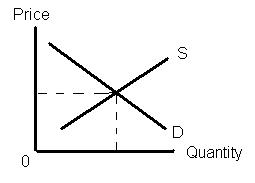
Demand Curve – shows quantities of a good demanded (that will be sold) at various prices. The higher the price the lower the quantity demanded and vice versa.

Think of it this way, if you have $10 in your pocket and an item costs $10 you can afford to purchase one unit of the item. But if the price is $5 you can afford to buy 2, and if price is $2.50 you can purchase 4, etc.

Further, since there are more middle and lower income people than rich people, the lower the price the greater the number of people who will be able to afford to buy the product and the more people able to afford the product the greater the quantity that will be demanded.

Supply Curve – shows quantities of a good supplied at various prices. The higher the price the greater the quantity supplied.

No business (supplier of a product or service) can afford to sell at a price lower than cost and remain in business. BUT all suppliers of a good do not face the same set of costs. A farmer with fertile soil, a good climate and sufficient rain can produce a larger crop, at a lower cost than a farmer growing the same crop in poor soil in the desert. The desert farmer incurs the same costs for seed, labor, etc. as the other farmer. But the desert farmer must also purchase fertilizer, install irrigation and pay for water. As a result, the desert farmer will have higher costs per bushel of product than the farmer in the ideal location. In order to make a profit on his crop, the desert farmer has to receive a higher price per bushel than the other farmer. The point is that producers of a good or service face different circumstances and some are able to produce at a lower cost (require fewer resources) than others. As the price of a good rises more producers are able to offer the good or service.

As a second example, consider yourself and the sale of your labor services. If you had tickets to a concert for tonight and your supervisor asked for a volunteer to work overtime at the regular hourly rate you probably would not volunteer. If double time was offered, you might be tempted but the desire to see the concert would probably be greater. But, if your supervisor offered a $1,000 bonus to put in an additional four hours this evening, doing your regular work, you would probably take the offer. As the price goes up you, as the seller of your labor services, are more inclined to increase the quantity of labor you are willing to provide. In this example the cost is your opportunity cost. If you earn $10 per hour and your concert ticket cost $50 the decision to volunteer or not is a no brainer since you will lose the $50 spent on the ticket and only gain $40 from working the four hours. If your supervisor offered you double time (i.e., $20 per hour) for the extra four hours you would earn $80 and lose $50 for a net gain of $30. More than likely the desire to see the concert would be greater than the $30 of additional net income so you would probably still turn down the extra work. But $1,000 or $250 per hour, for four hours of work would probably change the equation as the opportunity cost of giving up the extra pay ($1,000) dwarfs the $50 plus satisfaction of attending the concert.

In summary, the demand curve shows the various quantities of a good that will be demanded (i.e., consumers are willing and able to buy) at various prices, while the supply curve shows the various quantities of a good that will be supplied (offered for sale by producers) at various prices. The point where the two intersect is the point where the quantity demanded equals the quantity supplied and this is the equilibrium or market price.