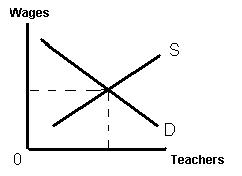
In my ten plus years of teaching economics I have come to expect that certain public policy topics, notably the environment, education and health care, will be approached by students more as articles of faith than topics to be discussed and analyzed. Essay question 3 of Exam 1 (which reads: Suppose local educators argue that teachers' salaries are too low. At the same time it is said that the school district received 750 applications for 5 new openings. Are salaries too low?) is a good example of this. The majority of the answers I have received so far automatically assume that teachers' salaries are exempt from the normal laws of economics and that they are underpaid.
Many tried to justify their position that teachers are underpaid by reversing the suppliers and consumers of teaching services. These students argued that the 750 applicants for 5 positions did not represent a surplus supply of teachers but, rather, a high demand for teaching positions. In this view school districts, rather than being buyers of teaching services are really providers of jobs for teachers. Of course, if this was the case, teachers would have to buy their jobs.*
Jobs are NOT an entitlement. Jobs exist solely because a producer reaches a point where he/she is unable to increase by their own efforts. At this point the producer hires others to provide the help needed to produce the additional output.
Parents want their children educated so an individual with the skills and knowledge to teach offers her teaching services for a fee. This person is successful but discovers that there are both more children to be taught and that the parents want, and are willing to pay for, more in depth teaching of various subjects. Rather than continuing to spend all day teaching a broad range of subjects to one group of thirty students, this entrepreneur hires additional teachers to specialize in various subjects. She is now able to rotate the students among different teachers for more in depth education in specific subjects and handle more than thirty students per day. She is meeting the needs of more consumers and making more money as a result of hiring the additional teachers. But note that she hired the additional teachers not because they needed a job or wanted to teach but because she needed their labor services to expand her business. Large businesses, including public school districts, differ from the entrepreneur/teacher above only in size.
Wages for teachers, or anyone else, are determined by market forces of supply and demand. Schools need teachers and a demand curve can be constructed showing what quantity of teaching services (or number of teachers) they are willing and able to hire at various prices (wage rates). Similarly, there is a pool of people with the skills and desire to teach. Like all workers, teachers, with their skills, have other job opportunities besides teaching so a supply curve can be constructed showing the various wages (prices paid for teaching services) and the corresponding number of teachers available at these various prices. The actual wage for any worker in competitive market is determined by the intersection of supply and demand.
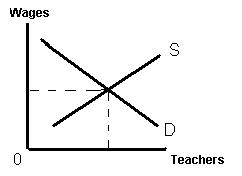
Market Supply and Demand for Teachers (equilibrium wage and equilibrium number of teaching positions)
When wages are set at a rate above the intersection of supply and demand there will be a surplus of people seeking positions. In the graph below note that at the current wage rate, which is above the equilibrium wage, the demand for new teachers is 5 while the supply of those available at that wage is 750. Note also that the 5 positions at the present wage rate is considerably LESS than the number of positions available at the market wage rate.
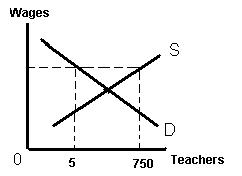
Situation where wage set above equilibrium wage level.
Proponents of increased spending on education argue that it is needed in part to enable schools to hire more teachers thereby decreasing the pupil to teacher ratio (i.e., smaller class sizes) and improving the quality of education. However, as shown in the graph above, the same could be accomplished by allowing teachers' wages to fall to market equilibrium levels. Allowing teachers' wages to fall to equilibrium levels would also result in an increase in the number of teaching jobs and this would eliminate part of the surplus of unemployed teachers. The remainder of the teacher surplus would disappear as those at the margin (i.e., those attracted to the profession because of the above market wage) saw teaching wages drop below the wages in alternative professions these people are equipped to enter. In this sense, the current above market wages are unfair to college students because they are encouraging these students to invest time and money in preparing for a profession that already has more trained professionals than it has jobs available. The losers in this situation, where we let market forces determine teacher wages, would be those currently working in the profession who would see their incomes decline.**
Today there exists both a SHORTAGE and a SURPLUS of K-12 teachers. Both are the result of K-12 education being provided primarily by the government rather than the private market and pay scales determined by political rather than market forces. The teacher SHORTAGE in general is limited to the areas of science and math while the SURPLUS is in the other subject areas. People trained in science or math are in HIGH demand by industry while people trained in areas like history face a much LOWER demand. If teacher salaries were set solely by market forces, science and math teachers would receive higher wages than teachers in areas like history.
Under the present teacher compensation system, all teachers within a district are paid according to the same scale regardless of subject. The scale is usually a compromise between the HIGHER wage needed to attract science and math teachers and the LOWER wage needed to attract teachers in other areas. This compromise results in a wage that is BELOW equilibrium for science and math teachers and ABOVE equilibrium for teachers of other subjects. Thus, those with a degree in science or math who want to teach have no problem finding a job right out of college while those with degrees in other subjects are often forced to accept jobs as substitute teachers, lower paying jobs in schools run by churches and other non-profits, part-time tutors or similar work for long periods as they continue to try to land one of the coveted positions, with above market pay, in their subject area.
*NOTE: This is not quite as far fetched as it sounds. In the eighteenth and early nineteenth centuries officer positions in England's army and the Royal Navy were sold to the highest bidder. Aristocratic parents (as well as wealthy merchants who sought to advance their sons socially) would purchase an appropriate military rank for their younger sons (the family titles and lands went, by law, to the oldest son). This gave the son both the status of the rank and the income (from the government) associated with the rank. When the holder of the commission was ready to either purchase a higher rank or retire he would sell the current commission to another.
**NOTE: Existing contracts and a need to maintain both morale and prevent the chaos resulting from the mass resignation of existing teachers would temporarily shelter existing teachers from direct cuts in pay. More than likely such a change would follow a path used by airlines and other industries needing to make substantial cuts in wages. In the case of airlines existing pilots maintained their present wages and many, but not all of their benefits and perks, while new pilots were hired at much lower wages and far fewer benefits and perks. In addition to the dual wage structure, the airlines severely restricted increases in wages and benefits for the existing pilots and, in some cases began to reduce benefits.
Your textbook has a brief discussion about school vouchers and, on Assignment 1 for the ECN 201 class and Homework 3 for the ECN 200 class, I have asked a question concerning school vouchers. I used this question in another class in a previous semester and many people had trouble with it either because they did not understand what a voucher was or, they were aware of school vouchers and were opposed to them. In both cases students focused on perceived negative effects of the vouchers on children's education and and answered accordingly. Their answers were wrong because they failed to read the question and answer what was being asked. The question is not about the educational effects of a voucher program (which is how most people answered it) but, rather, it is about who wins and who loses FINANCIALLY (hint, it isn't the students).
A voucher is a financial instrument, like a check, which can be exchanged by the recipient for a good or a service. Unlike a check which can be exchanged for cash and the cash used to purchase anything, a voucher can only be exchanged for a good or service stipulated by the issuer of the voucher. For instance, when an airline has to cancel a flight due to weather it will often direct stranded passengers to a nearby hotel and give them vouchers to pay for their rooms and meals at that hotel while waiting for the weather to clear and flights to resume.
The concept of school vouchers for K-12 education was first proposed by economist Milton Friedman about 30 years ago. As he explained in his popular TV series, declining educational achievement was due to the fact that schools, being public monopolies, had no incentive to use resources efficiently or to provide quality service. Public schools are supported by tax dollars which means that their funding is based upon political considerations and not by consumers. Further, the law not only requires that parents send their children to school but dictates which school to send them. With funds and students guaranteed, there is no incentive for schools to complete for students like private businesses compete for customers. Friedman's solution was to propose that instead of the government paying schools directly according to the number of students enrolled in the district, they instead divide the amount they would pay a district by the number of students to calculate the amount per student and give parents a voucher for that amount for each of their school-age children. Parents could then enroll their children in any school and pay for it with the voucher.
Contrary to what some critics of vouchers portray, vouchers can be used at any school, public or private. If parents do not like the school their child is assigned to under the present system, they can, under a voucher system, move the child to another school. This might be another public school in the same district, it might be another public school in another district or it might be a private school. Under this system, schools that are underperforming lose students and funding while schools that are providing a good education gain students and funding. Poorly run schools, both public and private, would go broke and cease to exist. Schools and their staffs (teachers, administrators, etc.) would be accountable to parents for their performance and would see their funding and jobs disappear if the quality of education delivered did not meet the expectations of parents (consumers). Special interest groups would also lose as projects and programs they wanted taught would disappear if parents were not interested in these programs (for example if parents felt phonics was the best way to teach children to read then schools that used phonics to teach reading would gain students (and the money they bring to the school) while schools that used other methods to teach reading would lose students and this would result in a sharp decline in the use of other methods.
School vouchers are one proposal to reform education in the U.S. They are not the answer to the problems of education in the U.S. but are merely one approach toward reform. (NOTE: Arizona is one of many states that does not have a voucher system). There are many critics of vouchers both from a free market perspective and from the perspective of defending the status quo. But what vouchers have accomplished is to move the debate over education from one of how much should we increase funding for public education and what reforms can we make to improve public education? to is public education the answer?. A half a century ago public education was a political sacred cow whose position in society was guaranteed. Today it is still the major provider of K-12 education but it is losing market share and is being hurt by competition on many sides for students and funding. This competition includes the growing use of unsubsidized (i.e., parents pay the full cost of private education with no help from the government) private schools (secular, religious and home schooling); programs that subsidize private schooling such as vouchers (when they can and are used to pay for private schools); tax programs like Arizona's tuition tax credit program (where taxpayers can contribute to scholarship programs that pay tuition for children (not their own) at private schools and receive a credit for this on their Arizona state income tax – i.e., if they donate $100 and their tax due is $900 they can subtract the $100 donation from the tax due and pay only $800 in state income tax – the state makes up for the loss of $100 in taxes by reducing spending for public education by $100); charter schools (Arizona is a leader in this area) which are publicly funded schools that can be operated by for profit, non-profit or public entities, have greater flexibility (i.e., fewer regulations) in designing and delivering education and are funded out of the same pool of funds as public schools; new accountability standards such as the federal No Child Left Behind Law and the state's AIMS testing program which are putting pressure on pubic schools to improve results noticeably or face additional sanctions and scrutiny by federal and state officials who control funding; finally, there is the growing reluctance by taxpayers to keep increasing funding for public schools as evidenced by school bond elections in which the proposed bonds are usually voted down and increasing voter support for legislative candidates who are beginning to challenge proposed increases in school funding.
Milton Friedman's voucher proposal, while bitterly opposed by many and not widely used, has succeeded in igniting a debate and unleashing forces which are transforming the K-12 education system in the U.S. At this point it is hard to predict what the end result will be. However, one can safely say that the free market dream of a totally private system in which parents have full control over their child's education and pay the full cost (possibly with private help) and no government funding or control of any kind will probably not be realized. However, it is also safe to say that when this process has played out, whatever role government will play in the new system will be greatly reduced (in terms of both funding and regulations) and the resulting public school part of the system will not be anything like the public education system your parents knew.



 Posts
Posts